
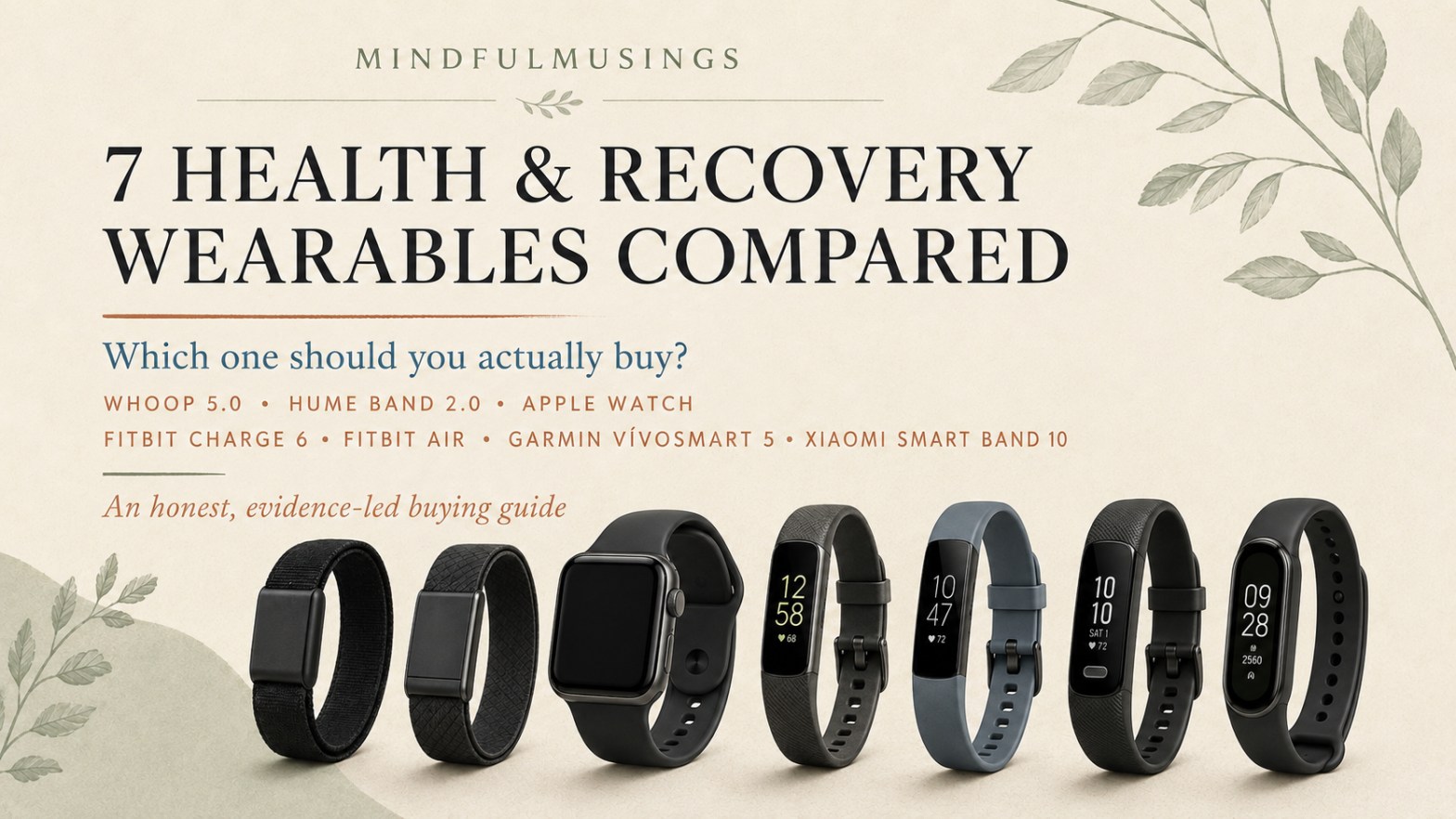
An honest, evidence-led comparison of WHOOP 5.0, Hume Band 2.0, Apple Watch, Fitbit Charge 6, Google Fitbit Air, Garmin vívosmart 5 and Xiaomi Smart Band 10.
Last fact-checked: 31 August 2026
First, an honest disclosure
I have worn an Apple Watch for roughly seven or eight years. I now wear WHOOP 5.0 as well. I have not worn the Hume Band 2.0—and I am not going to pretend that I have.
That matters.
There is a difference between a personal review and a researched comparison. My comments about living with Apple Watch and WHOOP come from personal experience. My assessment of Hume, Fitbit, Garmin and Xiaomi is based on published studies, official specifications, pricing, app features and the quality—or absence—of independent evidence for the exact device.
So, this is not a laboratory test. It is also not seven “hands-on reviews” conveniently stitched together.
It is an honest buying guide from someone trying to answer a much simpler question:
If I were spending my own money, which wearable would make the most sense for my goals?
No company has sponsored this ranking. If affiliate links are added to this article, they will not influence the scores or conclusions.
The short answer
If your main interest is recovery, strain, sleep and understanding how ready your body may be for training, my first choice is WHOOP 5.0.
If you want the strongest combination of smartwatch features, workout heart rate, GPS, safety features and broader health tools, Apple Watch remains the better all-round device—especially for an iPhone user.
If you want a sensible health tracker without committing to an expensive annual membership, Fitbit Charge 6 is probably the best-value middle ground.
Hume Band 2.0 is interesting because it promises a screen-free experience, long battery life and recovery-oriented insights without forcing every buyer into a subscription.
However, its exact-model independent evidence is currently much thinner than the evidence available for established Apple, Fitbit and WHOOP devices.
That does not prove that Hume Band 2.0 is inaccurate. It simply means I would not present its marketing claims as scientifically settled facts.
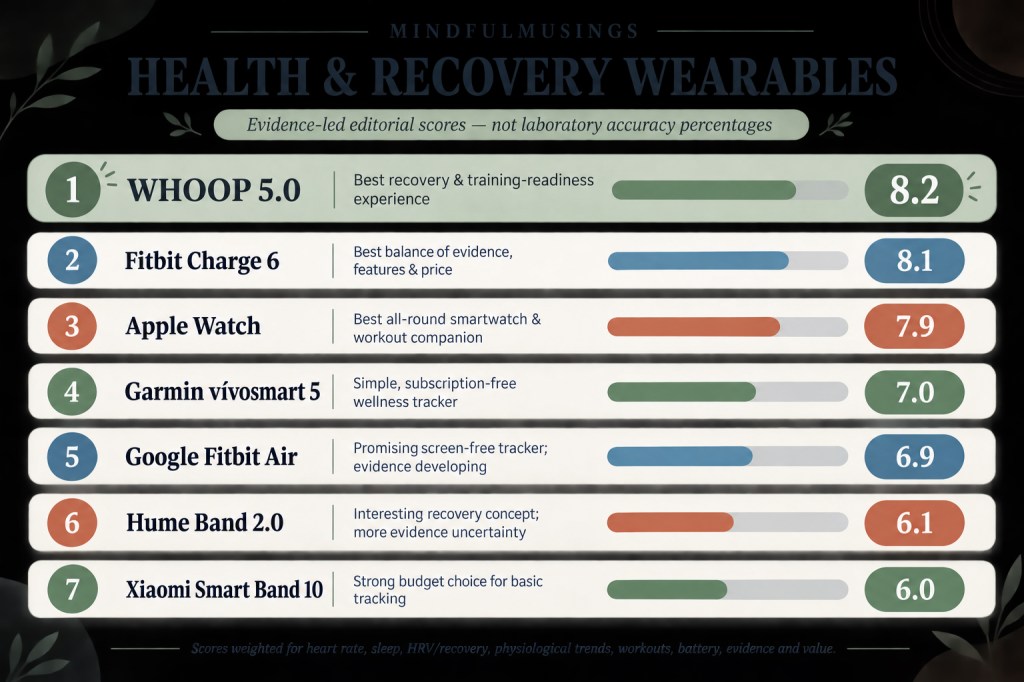
My health-and-recovery ranking
| Rank | Wearable | Score out of 10 | Best description |
|---|---|---|---|
| 1 | WHOOP 5.0 | 8.2 | Best recovery and training-readiness experience |
| 2 | Fitbit Charge 6 | 8.1 | Best balance of evidence, features and price |
| 3 | Apple Watch family | 7.9 | Best all-round smartwatch and workout companion |
| 4 | Garmin vívosmart 5 | 7.0 | Simple, subscription-free Garmin wellness tracker |
| 5 | Google Fitbit Air | 6.9 | Promising screen-free Fitbit, but evidence is still developing |
| 6 | Hume Band 2.0 | 6.1 | Attractive recovery concept with greater evidence uncertainty |
| 7 | Xiaomi Smart Band 10 | 6.0 | Excellent budget tracker but not an advanced recovery tool |
These are editorial scores, not laboratory accuracy percentages.
A score of 8.2 does not mean a device is “82% accurate,” and a lower score does not automatically make a device bad.
For this comparison, I weighted the categories for a person mainly interested in health, recovery and exercise:
- Workout and daily heart rate: 15%
- Sleep tracking: 12%
- HRV and recovery interpretation: 18%
- Continuous physiological trends: 18%
- Workout tracking: 10%
- Battery life and wearability: 8%
- Quality of published evidence: 12%
- Value for money: 7%
Change the question and the ranking will change.
Give more weight to GPS, ECG, apps and phone features, and Apple Watch will rise. Make battery life and price the main priorities, and Xiaomi becomes far more attractive.
Price and subscription comparison
Prices change depending on country, taxes, exchange rates and promotions. The figures below are approximate official US prices checked in August 2026.
Indian, UAE and other international prices may differ because of local distribution, GST or VAT, duties and promotional offers.
| Wearable | Initial or advertised price | Mandatory subscription? | Optional charges | Approximate three-year base cost* |
|---|---|---|---|---|
| WHOOP 5.0 One | Device included | Yes—$199 per year | Higher plans add features | $597 |
| WHOOP 5.0 Peak | Device included | Yes—$239 per year | — | $717 |
| WHOOP MG/Life | Device included | Yes—$359 per year | — | $1,077 |
| Hume Band 2.0 | Usually $199–$249 one time | No | Hume Premium from $8.99 per month | $199–$249, or approximately $523–$573 with 36 months of Premium |
| Apple Watch | Approximately $249–$799+, depending on model | No | Cellular plan, third-party apps or Fitness+ if wanted | Hardware price |
| Fitbit Charge 6 | Approximately $159.95 | No | Premium health services are optional | $159.95 |
| Google Fitbit Air | Approximately $99.99 | No | Google Health Premium is optional | $99.99 |
| Garmin vívosmart 5 | Approximately $149.99 at reference price | No | No membership needed for core Garmin Connect features | $149.99 |
| Xiaomi Smart Band 10 | Usually around $40–$60 equivalent | No | None required | Hardware price |
*Before taxes, replacement straps, repairs, accidental damage and future price changes. This is not a claim that every device or battery will necessarily last exactly three years.
The ownership model is worth considering before comparing features.
WHOOP can initially look inexpensive because the hardware is included. However, it becomes one of the costliest options when used for several years because the membership is essential to the experience.
Hume Band 2.0 can be used without its optional Premium plan. Apple, Fitbit, Garmin and Xiaomi are more conventional hardware purchases, although optional services, cellular plans and third-party apps can add to the cost.
Before buying, check the latest prices on the official WHOOP membership page, Hume Band comparison page, Apple Watch store, Fitbit Charge 6 page and Google Fitbit Air page.
What does “accurate” actually mean?
“Which wearable is the most accurate?” sounds like one question.
In reality, it is several different questions.
A wearable can be excellent at measuring steady-state heart rate but struggle during weight training, interval training or activities involving rapid wrist movement.
It can estimate when you fell asleep reasonably well while still confusing light, deep and REM sleep.
It can measure HRV consistently at night but convert that measurement into a recovery score that you do not find particularly useful.
There are at least four different comparisons hiding inside the word “accuracy”:
- Sensor agreement: How closely does the reading match a trusted reference such as an ECG, chest strap or sleep-laboratory test?
- Consistency: Does the device measure you in a similar way from one day or night to another?
- Interpretation: Does the app convert those signals into understandable and useful guidance?
- Behavioural value: Does the information actually help you improve your sleep, training or recovery?
No single wearable wins all four.
1. WHOOP 5.0: best for recovery-led training
Best for: People who want sleep, strain and recovery to guide their training decisions—and who are comfortable paying every year.
WHOOP’s advantage is not that every individual sensor reading has been conclusively proven superior to every competitor.
Its biggest advantage is the way the entire experience is built around recovery.
There is no distracting watch face and no collection of phone apps sitting on your wrist. You wear it continuously, charge it while wearing it, and wake up to a recovery score informed by trends such as resting heart rate, HRV, sleep and respiratory rate.
The strain score then gives that recovery information practical context.
That focus matters.
Apple gives me more individual tools. WHOOP more directly tries to answer the question:
How hard should I push myself today?
What I like about WHOOP 5.0
- Recovery, strain and sleep are connected in one understandable system.
- Its screen-free design encourages near-continuous wear.
- The claimed 14-plus-day battery life reduces gaps in the data.
- The WHOOP Journal can help connect habits such as alcohol, late meals, stress or supplements with changes in recovery.
- It is particularly useful for people who want trends and coaching rather than another smartwatch.
- It turns several complicated physiological measurements into information that is relatively easy to understand.
What I would think about twice
- The membership is mandatory and becomes expensive over several years.
- A recovery score is an algorithmic interpretation, not a medical assessment.
- WHOOP 5.0 will not replace a GPS sports watch for everyone.
- A phone or another device may still be needed for routes and live workout information.
- ECG and blood-pressure-related features belong to the WHOOP MG/Life tier—not the standard WHOOP 5.0 hardware.
- Feature availability and regulatory clearance can vary by country.
- Much of the published validation still relates to WHOOP 4.0 rather than the newer WHOOP 5.0.
One 2025 study reported strong agreement for night-time HRV measured using WHOOP 4.0. However, using that study as evidence for WHOOP 5.0 remains a family-level inference—not exact-model validation.
That distinction should not be hidden.
You can read the HRV study here.
My verdict: WHOOP is my first choice for recovery-oriented use because its interpretation feels more coherent and actionable—not because I believe it has magically perfected every physiological measurement.
2. Fitbit Charge 6: the sensible value choice
Best for: Someone who wants reliable everyday health and fitness tracking, built-in GPS and useful health features without a compulsory annual fee.
Fitbit Charge 6 may be less fashionable than the newer screen-free recovery bands, but it makes a very strong buying case.
It offers continuous heart-rate tracking, sleep tracking, built-in GPS, ECG and EDA-related features in a compact device. Certain functions can depend on country, age and account requirements.
Its biggest advantage in this comparison is that it combines an accessible price with published evidence for the exact model.
In a 2026 heart-rate validation study, Charge 6 recorded a mean absolute error of 4.5 beats per minute and a concordance correlation coefficient of 0.93 across the study conditions. It performed best among the devices included in that particular study.
That does not guarantee identical performance for every person, wrist, skin type, activity or environment. However, it is still meaningful evidence.
You can read the study in JMIR Formative Research.
Pros of Fitbit Charge 6
- Strong balance of features and price.
- No mandatory subscription for core tracking.
- Built-in GPS.
- Exact-model heart-rate validation is available.
- Small and comfortable enough for sleep tracking and everyday wear.
- Includes more health-related features than many similarly priced trackers.
Cons of Fitbit Charge 6
- Its recovery and coaching experience is not as focused as WHOOP’s.
- Some deeper insights require an optional paid service.
- Its small screen is useful but not ideal for detailed workout navigation.
- Google’s evolving health ecosystem may feel less settled than Apple or Garmin.
My verdict: If a friend wanted one compact health tracker, disliked subscriptions and did not require a complete smartwatch, Fitbit Charge 6 would be one of my easiest recommendations.
3. Apple Watch: the best all-rounder, but not necessarily the best recovery band
Best for: iPhone users who want smartwatch functions, workouts, GPS, health features and safety tools in one device.
After wearing an Apple Watch for seven or eight years, I would never describe it as “just a step counter.”
It is a capable workout watch, communication device, safety tool and health platform.
Depending on the particular model and country, the Apple Watch family can include features such as:
- ECG
- Irregular-rhythm notifications
- Temperature sensing
- Sleep-apnoea notifications
- Fall detection
- Crash detection
- GPS
- Cellular connectivity
- Sleep tracking
- Training-load information
However, Apple Watch and WHOOP are answering two different questions.
Apple Watch is better at being a watch and a connected health computer.
WHOOP is better at making recovery the centre of the experience.
Apple’s newer software has improved its sleep and training insights, but the need for frequent charging can still interrupt continuous wear—especially if the same watch needs to cover daytime activity, workouts and sleep.
Pros of Apple Watch
- Strong workout heart-rate performance in several studies.
- A relatively broad body of independent research.
- Excellent GPS and exercise-app selection.
- Useful ECG and cardiac notifications on supported models and in supported countries.
- Mature integration with iPhone and Apple Health.
- Safety, communication and everyday smartwatch functions go far beyond a conventional fitness band.
- No mandatory subscription for core health data.
Cons of Apple Watch
- Shorter battery life than WHOOP, Hume, Fitbit, Garmin and Xiaomi bands.
- Recovery is one part of a much larger product rather than the central purpose.
- Notifications and apps can be distracting for someone who specifically wants a screen-free tracker.
- “Apple Watch” is not one fixed sensor package. Features and accuracy can vary by generation, model, fit and software.
- It only works with iPhone.
A living systematic review of Apple Watch validation research found encouraging performance for several measurements but also considerable variation by model, population and testing conditions.
For sleep, consumer watches are generally better at identifying sleep than detecting quiet wakefulness or perfectly distinguishing every sleep stage.
You can read the Apple Watch systematic review here.
My verdict: Apple Watch is not automatically “less accurate overall” than WHOOP because there is no scientifically honest single measurement called overall accuracy.
Apple is stronger in certain areas and less recovery-focused in others.
For my specific goal—understanding strain, sleep and training readiness—I find WHOOP more useful.
For an iPhone owner who wants one device to handle almost everything, I would choose Apple Watch.
4. Garmin vívosmart 5: simple, steady and subscription-free
Best for: Someone who wants Garmin’s health ecosystem in a small band and does not require built-in GPS or sophisticated smartwatch functions.
The vívosmart 5 is not one of Garmin’s newest high-end sports watches.
That is also part of its appeal.
It tracks heart rate, sleep, stress, Pulse Ox and Body Battery in a slim format. Its connected GPS uses a paired phone for outdoor route and distance information.
Pros of Garmin vívosmart 5
- No mandatory subscription for core Garmin Connect features.
- Approximately seven days of battery life.
- Body Battery provides a simple view of energy and recovery trends.
- 5 ATM water rating.
- Particularly suitable for someone already using Garmin products.
Cons of Garmin vívosmart 5
- It uses connected rather than built-in GPS.
- The hardware is more basic than premium Garmin watches.
- In the 2026 heart-rate study cited earlier, its agreement was weaker than Fitbit Charge 6.
- Sleep stages and recovery scores should still be treated as estimates.
My verdict: It is a practical, subscription-free tracker, particularly for an existing Garmin user. However, it would not be my first choice if advanced recovery interpretation were the main priority.
5. Google Fitbit Air: promising but still too new for an accuracy crown
Best for: Someone who wants a light, screen-free tracker within Google’s health ecosystem at an accessible price.
Fitbit Air is conceptually one of the closest rivals to WHOOP and Hume.
It has no screen and focuses on continuous tracking, including sleep, heart rate, HRV, SpO2, readiness and cardio load. Google advertises up to seven days of battery life.
The problem is not an obvious weakness in the device.
The problem is timing.
As a newer model, it does not yet have the same level of exact-device independent validation available for Fitbit Charge 6 or established Apple Watch generations.
Pros of Google Fitbit Air
- Screen-free design suits sleep tracking and continuous wear.
- Lower upfront price than most recovery-focused competitors.
- Core Google Health tracking does not require Premium.
- Compatible with Android and iOS under Google’s stated requirements.
- Fits the needs of people who want health tracking without another screen.
Cons of Google Fitbit Air
- Limited exact-model independent validation is currently available.
- It is less mature as a product than Fitbit Charge 6.
- Deeper coaching is connected to the optional Google Health Premium service.
- Because it has no screen, you need a phone to view information.
My verdict: Fitbit Air looks promising and may offer good value. However, I would keep its score provisional until independent research catches up with the product.
6. Hume Band 2.0: an interesting idea with an incomplete independent picture
Best for: Someone who wants a screen-free recovery tracker, long battery life and no compulsory subscription—and accepts that its independent evidence base remains limited.
Hume Band 2.0 is probably the easiest product in this comparison to either oversell or dismiss unfairly.
The company lists:
- 24/7 heart rate
- Heart-rate variability
- SpO2
- Skin temperature
- Sleep tracking
- Strain
- Recovery information
- Five LEDs and four photodiodes
- IP68 protection
- Up to 14 days of battery life
Those are attractive specifications.
The absence of a mandatory subscription is also a genuine advantage over WHOOP.
What I could not locate was a substantial body of peer-reviewed and independent validation for the exact Hume Band 2.0 model across heart rate, HRV, sleep stages and recovery.
Company specifications tell us what a device measures or estimates. They do not, by themselves, prove how closely every output agrees with a medical or laboratory reference.
Pros of Hume Band 2.0
- Up to 14 days of claimed battery life.
- Screen-free and designed for continuous wear.
- No mandatory membership for core use.
- Tracks several physiological signals used in recovery models.
- Lower long-term base cost than WHOOP when used without Premium.
- Provides an alternative for people who want recovery information without another screen.
Cons of Hume Band 2.0
- Limited exact-model independent evidence is currently available.
- Ambitious health claims require careful reading.
- Buyers need to check whether a feature is a wellness estimate, region-limited, pending a software update or subject to regulatory clearance.
- No built-in display or complete smartwatch functionality.
- Its recovery and longevity positioning has not yet received the same level of independent scrutiny as Apple, Fitbit or WHOOP.
I would never turn “I could not find enough independent validation” into “the device is inaccurate.”
Those are two completely different claims.
The fair conclusion is that the uncertainty is greater.
My verdict: Hume Band 2.0 may suit someone who values battery life, a screen-free design and avoiding mandatory membership fees.
I would buy it for that ownership proposition—not because enough independent evidence already exists to declare it the world’s most accurate health wearable.
You can check the current specifications and offers on Hume’s official Band 2.0 page.
7. Xiaomi Smart Band 10: best for a limited budget
Best for: Casual activity, sleep and wellness tracking at a low upfront price.
Xiaomi’s Smart Band range has always made expensive trackers look slightly uncomfortable.
Smart Band 10 offers an AMOLED display, heart rate, SpO2, sleep and stress tracking, more than 150 sports modes, 5 ATM water resistance and claimed battery life of up to 21 days under typical-use assumptions.
Pros of Xiaomi Smart Band 10
- Easily the lowest-cost option in this comparison.
- Excellent claimed battery life for the price.
- Bright display and a broad list of activity features.
- No mandatory subscription.
- Widely accessible in India and several international markets.
Cons of Xiaomi Smart Band 10
- Limited independent evidence is available for the exact Band 10 model.
- It does not have built-in GPS.
- Phone pairing may be required for route tracking.
- Recovery insights are less sophisticated than WHOOP’s.
- Studies involving older Mi Band models should not be treated as proof for the newest version.
My verdict: It is the best-value option for basic fitness and wellness tracking.
I would not buy it expecting laboratory-quality sleep staging or advanced recovery coaching. However, at this price, it does not need to beat WHOOP at WHOOP’s job.
You can view Xiaomi’s official Smart Band 10 specifications here.
What does the independent research really tell us?
Heart rate: usually useful but never flawless
Optical heart-rate sensors can perform well at rest and during steady exercise.
Their accuracy can become less reliable during:
- Rapid arm movements
- Interval training
- Resistance training
- Activities involving repeated wrist movement
- Cold conditions
- Poor device fit
- Tattoos around the sensor area
- Changes in skin contact
In the 2026 comparative study, Fitbit Charge 6 performed strongly overall. Apple Watch SE and Garmin vívosmart 5 also produced useful but condition-dependent results.
The study found that irregular movement reduced accuracy.
One study cannot rank every wearable in every possible sport. However, it reinforces the idea that the type of activity can matter almost as much as the brand.
If precise live heart rate is particularly important for your training or safety, a validated chest strap remains a more appropriate reference than assuming any wrist-based device will always be perfect.
Sleep: total duration is more believable than every sleep stage
Consumer wearables are generally better at estimating whether someone is asleep than detecting quiet wakefulness or perfectly distinguishing light, deep and REM sleep.
In a 2025 study against polysomnography, Apple Watch Series 8, Fitbit Charge 5, WHOOP 4.0 and Garmin vívosmart 4 all showed limitations.
Apple Watch had the strongest sleep-and-wake agreement among those devices in that particular study, but none of them reproduced a clinical sleep laboratory.
You can read the sleep study here.
That is why I pay greater attention to repeated trends such as:
- Bedtime
- Total sleep time
- Sleep consistency
- Changes from my normal baseline
- How the data matches how I actually feel
I pay less attention to whether a consumer band tells me that I received exactly 63 minutes of deep sleep.
HRV and recovery: personal trends matter more than comparison with friends
HRV can be influenced by:
- Age
- Health
- Mental stress
- Alcohol
- Sleep
- Training load
- Illness
- Measurement timing
- The algorithm and sampling method used by the device
A single HRV reading is rarely as useful as a trend measured under similar conditions.
WHOOP’s strength is measuring HRV during sleep and converting the trend into a consistent recovery framework.
Garmin and Fitbit also interpret recovery-related signals, while Apple provides HRV information and an expanding range of training and overnight measurements.
However, different devices can use different sampling schedules and algorithms. Comparing an Apple HRV reading directly with a WHOOP HRV reading may therefore be misleading.
Use the same device consistently. Understand your normal baseline. Pay attention to changes that match—or fail to match—how you actually feel.
Calories: treat every figure as an estimate
This is the area where wearable confidence often exceeds wearable evidence.
A systematic review found weak accuracy for energy-expenditure estimates across commercial wearables. Mean absolute percentage errors exceeded 30% across brands in the reviewed research.
You can read the systematic review here.
I use wearable calorie estimates to compare my own activity patterns.
I would not treat the number as permission to “eat back” a precise quantity of calories.
So, which wearable should you buy?
Buy WHOOP 5.0 if…
You train regularly, care about sleep and recovery, want the app to convert physiological trends into daily guidance, and accept the annual cost.
It is my choice for the clearest recovery experience.
Buy an Apple Watch if…
You use an iPhone and want one device for workouts, GPS, supported ECG features, notifications, safety, apps and everyday life.
It is the best all-rounder in this comparison, even though it is not my first recovery-only choice.
Buy Fitbit Charge 6 if…
You want the most balanced answer: useful health tracking, built-in GPS, a small screen, credible exact-model heart-rate evidence and no compulsory subscription.
It is the practical value winner.
Buy Garmin vívosmart 5 if…
You already use Garmin Connect, want Body Battery and prefer a simple band without ongoing fees.
Consider a more advanced Garmin sports watch if serious GPS training tools are important to you.
Consider Google Fitbit Air if…
You want an affordable, screen-free Google health tracker and are comfortable purchasing a newer product before a large independent validation record has developed.
Consider Hume Band 2.0 if…
You want a long-battery, screen-free recovery tracker without mandatory membership charges.
Go in with realistic expectations. Its concept is appealing, but the independent evidence for exact-model accuracy is not yet deep enough for me to rank it above the better-studied options.
Buy Xiaomi Smart Band 10 if…
Budget and battery life matter more to you than advanced recovery interpretation.
For everyday steps, basic workouts and general wellness trends, it offers a great deal for the money.
My personal conclusion
I do not believe Apple Watch is automatically “better than WHOOP” at understanding the body.
I also do not believe WHOOP is universally more accurate than Apple Watch.
Apple Watch gives me the stronger workout-and-smartwatch package.
WHOOP gives me a clearer story about recovery.
That story is why WHOOP ranks first in this particular comparison.
If I wanted one device for my entire digital life, I would choose Apple Watch.
If I wanted a wearable specifically to influence how I train, sleep and recover, I would choose WHOOP.
If I wanted to spend less and avoid an annual bill, I would buy Fitbit Charge 6.
And Hume?
I would keep it in the conversation, but with the label I believe it currently deserves:
Promising, feature-rich and not yet independently proven enough to receive the accuracy crown.
That is not an insult or an attempt to demean the product.
It is simply the most honest conclusion I can reach from the evidence available today.
Editorial and medical disclaimer
Consumer wearables monitor fitness and wellness signals. They do not diagnose every symptom or replace a doctor, medical ECG, sleep study or other clinical assessment.
Features involving ECG, blood-pressure insights, SpO2 and health notifications may vary by model, country, age, software version and regulatory clearance.
Speak to a qualified medical professional about persistent symptoms or concerning readings.
Prices, subscriptions and product features can change. Check the manufacturer’s local website immediately before purchasing.
The rankings in this article combine published research with editorial judgement. They should not be represented as a clinical accuracy league table.
Sources and further reading
- Comparative heart-rate validation of Fitbit Charge 6, Apple Watch SE and Garmin vívosmart 5—JMIR Formative Research, 2026
- Consumer wearable sleep staging compared with polysomnography—Sleep Advances, 2025
- Living systematic review of Apple Watch validation—npj Digital Medicine, 2025
- Nocturnal HRV agreement including WHOOP 4.0—Physiological Reports, 2025
- Systematic review of wearable heart rate, energy expenditure and step-count accuracy
- WHOOP membership options
- Hume Band 2.0 official specifications
- Apple Watch buying page
- Fitbit Charge 6 official page
- Google Fitbit Air official page
- Garmin vívosmart 5 official overview
- Xiaomi Smart Band 10 official specifications
About the author
I write about fitness, health, wellness, life experiences and the imperfect process of understanding our bodies through technology.
I have worn an Apple Watch for roughly seven or eight years and currently use WHOOP 5.0. Whenever I have not personally tested a product, I say so and base my assessment on publicly available evidence rather than pretending otherwise.

